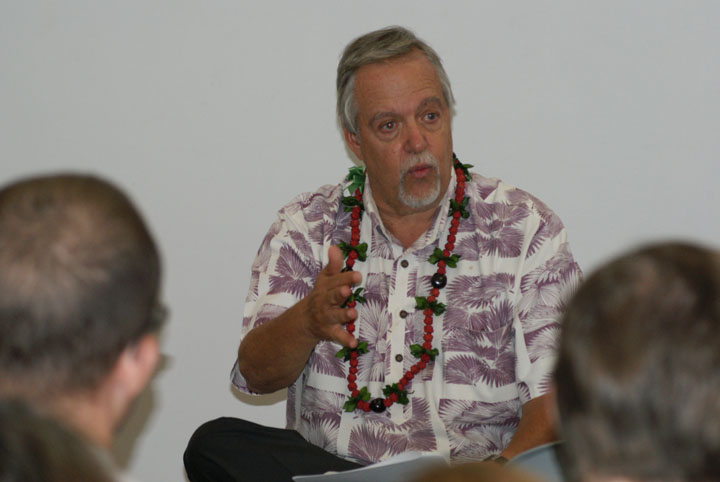
By Gerald Kato and Jeff Portnoy, Esq.
Hawai`i journalists have long faced the threat of having to reveal
confidential sources of information. There’s no newsperson’s privilege statute,
nothing in the Hawai`i Rules of Evidence, and the only case decided by the state
Supreme Court said there is no constitutional right to conceal the identity of
sources. But, Hawai`i may soon take a giant stride from one of worst states
without a so-called "shield law" to protect a journalist from revealing sources
to a state with one of the best shield laws in the country.
On April 29, 2007, the Legislature passed HB 2557, which will make Hawai`i
the 36th state in the country, along with the District of Columbia,
to protect journalists and their sources. The new law will protect journalists
employed by newspapers, magazines, and radio and television stations. And, in
recognition of the changing media environment, it extends protection to
non-traditional journalists such as bloggers if they work in the public interest
and they hold a position similar to traditional journalists.
A lot of credit for supporting and shepherding the bill through the
Legislature goes to Rep. Blake Oshiro (D), vice chair of the House Judiciary
Committee. Last fall, Oshiro, who took an interest in the subject, contacted the
Society of Professional Journalists and the Honolulu Community-Media Council to
discuss drafts of a shield law bill that he was introducing.
The House Judiciary Committee took up Oshiro’s bill on Feb. 5, 2008. The bill
generated a lot of concern nationally because it included a provision that those
covered by the law follow journalism codes of ethics. Oshiro was flexible and
moved the bill on for discussion without the ethics provision. At this point,
the bill worked its way through the House. By late February, a news media
coalition was organized to support passage of the bill. We—Portnoy and
Kato—formed a task force together with Honolulu Community-Media Council
President Chris Conybeare, and Honolulu Advertiser Editor Mark Platte.
In the Senate, the bill faced major opposition from the Attorney General’s
Office and the law enforcement community. The Senate Judiciary Committee urged
negotiations between the news media and the Attorney General’s Office. It was
not until late March that discussions got underway between Portnoy and Attorney
General Bennett. Beyond a new draft of the bill offered by Bennett, there did
not seem to be much to talk about because of major differences between what
Bennett thought was essential and what the news media was willing to accept. The
bill seemed headed for the scrap heap. But, on the last possible day to get it
out of committee, April 22, we got together with Oshiro to do some serious
bargaining. Portnoy went nose-to-nose with Bennett on key points with Bennett
willing to compromise while maintaining the need to protect the interests of law
enforcement. With some added assistance from Oshiro, an agreement was reached
that we believe strikes a balance between the journalists’ responsibilities to
their source and their responsibilities as citizens of the community.
Like any compromise agreement that’s a product of the legislative process, we
didn’t get everything we wanted and neither did the Attorney General.
Nonetheless, the bill that emerged without a doubt advances the interest of the
free flow of information in Hawai`i. Here’s how.
It protects journalists from being compelled to disclose confidential sources
of information that could lead to a source’s identity. In addition, it protects
any non-confidential newsgathering materials that has not been published or
broadcast such as outtakes, photographs, and notes. This is significant because
unpublished materials have frequently been a point of contention between the
local news media and lawyers who have been issuing subpoenas seeking such
materials.
As with most shield laws, there are exceptions. The shield law privilege is
qualified in felony cases where there is "substantial evidence" the information
is material to the investigation. In such cases, the privilege would be subject
to a three-part test: (1) if the information sought is otherwise unavailable
through other sources: (2) noncumulative, and; (3) necessary and relevant to the
charge, claim or defense asserted. If not insurmountable, this is a major
barrier to those seeking to force disclosure by journalists. There’s an absolute
privilege in anything less than a felony and all civil cases, except defamation.
Defamation cases would be subject to the same three-part test as felony
cases.
The privilege is lost if the person claiming the privilege has committed, is
committing or planning to commit a crime. Neither would the privilege apply if
the person claiming the privilege observes the alleged commission of a crime so
long as the crime in question was not the disclosure of the information. And,
the privilege would not apply when the information is "important to help prevent
imminent harm to life or public safety." In all such cases there were be a
review by the courts.
While this may sound like a lot of exceptions, the fact is the bill provides
ample protections to ensure that subpoenas to reveal sources will be limited.
Prosecutors and attorneys will know the rules and the rules make it clear that
trying to force testimony from a journalist should be the last resort and
subject to restrictions.
For some, a major stumbling block in the bill is that it includes a shapeless
category of designated as non-traditional journalists. Traditional journalists
in the mainstream news media fear this gives protection to irresponsible
bloggers unrestrained by ethical standards. Bloggers, on the other hand, say
they should not be subjected to different requirement from traditional
journalists for protection. Clearly, owning a laptop computer doesn’t make you a
journalist; but there those such as documentary filmmakers, book authors, and
bloggers who do work that would be considered journalism by any definition. This
bill takes a practical approach by protecting those whose intent is to gather
news and information in the public interest without regard to how they
disseminate that news and information. That should be what the free flow of
information is all about.
As we said at the outset, we think this is one of the best shield
laws in the country and protects the interest of every journalist in Hawai`i
whether they’ve been subject to a subpoena or not. But don’t get too
comfortable. Lawmakers—for reasons of their own-- put a sunset provision in the
bill that says it will expire in three years. We expect to see SPJ and every
news media organization in Hawai`i on the frontlines at the Legislature to
defend a bill we believe is worth preserving.
Lingle signs Reporter's Shield Law
A bill granting
protection to the identities of confidential
news sources and reporters' notes in many circumstances has been signed
into law by Gov. Linda Lingle.
Look for a forum soon as attorney Jeff Portnoy explains
what protections are granted by the law.
House and Senate conferees
agreed on changes to House Bill 2557, which provides protection of
confidential sources for those in the traditional media as well as many in
electronic media.
Its chief sponsor
is Rep. Blake Oshiro.
Bills from the 2008
Legislature:
PUBLIC MEETINGS
|
|
HB 128, HD1
|
Sen. Jud.
|
NB private discussions at other
meetings
|
HB 849
|
Killed
|
More than 2 bd members can attend
other mtgs.
|
HB 994
|
Killed
|
Board with no quorum, can still
receive test.
|
HB 1512, HD1
|
Deferred
|
Public input, action on item not on
NB agenda
|
| |
|
NB other meetings
|
HB 1620
|
House Jud.
|
Allows for chance meetings of NB
members
|
HB 1779
|
House Jud.
|
Allows more than 2 bd members to go
to info.
|
| |
|
mtgs., more to meet in
investigative matter
|
HB 1903
|
House Jud.
|
Allows testimony on broad agenda
item
|
HB 1968
|
Senate Jud.
|
Bd private discussions at other
meetings
|
HB 2216
|
Senate Jud.
|
2 or more bd. Members can meet
|
HB 2429
|
WLH, HED, TAC
|
Sports Authority exemption from
Sunshine Law
|
HB 2730
|
Passed Conference
|
Procedures for item not on NB agenda http://www.capitol.hawaii.gov/session2008/Bills/HB2557_CD1_.htm
|
HB 2950
|
House Jud.
|
Bd private discussions at other
meetings
|
SB 250
|
Sen. Jud.
|
Board with no quorum, can still
receive test.
|
SB 1692
|
Sen. Jud.
|
Allows testimony on broad agenda
item
|
SB 1706
|
Sen. Jud.
|
Public input, action on item not on
NB agenda
|
| |
|
NB other meetings
|
SB 2174
|
House Jud.
|
2 or more bd. Members can meet
|
SB 2201
|
Deferred House Jud
|
Public input, action on item not on
NB agenda
|
SB 2295
|
Deferred House Jud
|
Bd private discussions at other
meetings
|
| |
|
Polling
|
SB 2371
|
Sen. Inter Gov, Jud.
|
Public input, action on item not on
NB agenda
|
| |
|
NB other meetings
|
SB 2609
|
Sen. Jud.
|
Announce description of items at
exec. sess.
|
SB 2936
|
Sen. Jud.
|
Public meetings for community
advisory bds.
|
| |
|
|
PUBLIC RECORDS
|
|
HB 913
|
House Jud.
|
Removes property tax info from
disclosure
|
HB 1489
|
House Jud.
|
Makes public charges upon ethics
disposition
|
SB 634
|
Sen. Jud.
|
Authorizes OIP to issue adm. Fines
for lack
|
| |
|
of disclosure
|
SB 945
|
House Jud.
|
Requires judges to file fin. Discl.
With state
|
| |
|
Ethics Commission
|
SB 1298
|
Sen. Jud.
|
Makes public charges upon ethics
disposition
|
SB 1233
|
Sen. Jud.
|
Removes property tax info from
disclosure
|
SB 1489
|
Sen. Jud.
|
Makes public charges upon ethics
disposition
|
SB 1557
|
Sen. Jud.
|
Requires fin. Discl. Of certain bd
members
|
| |
|
to be public
|
SB 1953
|
Sen. Jud.
|
Requires public fin. Discl. Of
nominated judges
|
SB 1957, HD1
|
Conf. Com. Carryover
|
Requires fin. Discl. Of all bd
members
|
SB 2320
|
Sen. Jud.
|
Electronic disclosure of record if
record sought
|
| |
|
electronically
|
SB 2602
|
Sen. Jud.
|
Requires fin. Discl. Of members of
major bds.
|
SB 2611
|
Sen. Jud.
|
Counties allow for more openness in
public
|
| |
|
inspection of records -- it applies
|
SB 2618
|
|
Audit of public, education, govt.
Program
|
SHIELD LAW
|
|
|
HB 1986
|
House Jud.
|
Shield law privilege for current
and former
|
| |
|
editorial employees of news
organizations
|
HB 2557
|
House Jud.
|
Shield law privilege for current
and former
|
| |
|
journalist or newscaster
|
SB 2473
|
Sen. Jud.
|
Shield law privilege for any agent
or other
|
| |
|
of entity regularly gathering and
publishing news
|
OFFICE OF INFORMATION PRACTICES
|
HB 2217
|
House Jud.
|
60 days to issue an opinion
|
HB 3182
|
House Jud.
|
Authorize OIP to conduct inquiry
for meetings
|
HB 3183
|
House Jud.
|
Allow board onsite inspections if
public part. Impracticable
|
SB 2175
|
Sen. Jud.
|
60 days to issue an opinion
|
SB 3104
|
Sen. Jud.
|
Authorize OIP to conduct inquiry
for meetings
|
SB 3105
|
Sen. Jud.
|
Allow board onsite inspections if
public part. Impracticable
|